
Places of Interest in Patras
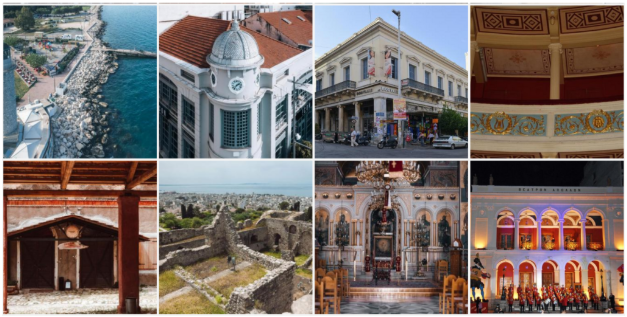
(source ://explore.patras.gr/patra-today/ )
City of Patras
In the 19th and 20th centuries, Patras became an important commercial and industrial center and the main exporting hub of Greece to Western Europe. Today, it remains one of the country's major ports and the capital of Western Greece. With a population of approximately 250,000, Patras is connected to the major cities of Greece and Europe by land, sea, and air.
Archaeological Museum of Patras
Located on the highway leading to Athens, the Archaeological Museum of Patras is one of the city's landmarks, distinguished by its modern architectural design. The museum features spacious exhibition areas, conservation laboratories, conference facilities, a multimedia room, a museum shop, parking, and a hall for temporary exhibitions. Its permanent collection is organized into thematic sections displayed in three impressive galleries.
Source: Archaeological Museum of Patras
Fortress of Patras
The Fortress of Patras was built during the second half of the 6th century A.D. on the ruins of the ancient Acropolis. Throughout its long history it served as the city's main defensive, administrative, and military center. Over the centuries it was occupied by the Franks, Venetians, Palaiologoi, and Ottomans.
The castle consists of an outer triangular enclosure with towers and bastions, as well as an inner fortified enclosure. Its surviving structures illustrate the various construction phases carried out by successive rulers according to the military needs of each era.
Source: Fortress of Patras
Saint Andrew Cathedral
The Church of Saint Andrew in Patras was built between 1836 and 1843 and is an outstanding example of neoclassical architecture. It was designed by Lysandros Kavtatzoglou in collaboration with renowned craftsmen and artists of the period. The church follows the architectural style of a three-aisled basilica.
Next to the church stands the Anglican Church of Saint Andrew, dating from 1878, a building of significant architectural and historical importance for the city.
Source: Saint Andrew Monument Information
Achaia Clauss Winery
Achaia Clauss, located on the hill bearing its name, was founded in 1861 by the Bavarian Gustav Clauss. The historic Winecastle remains preserved today and is one of Greece's most famous wineries.
In 1873 Gustav Clauss created the famous sweet red wine Mavrodaphne, naming it after his beloved Daphne. He is also considered the pioneer of wine tourism in Greece.
More information: Achaia Clauss Winery
Rio–Antirrio Bridge
The Rio–Antirrio Bridge, completed in 2004, is one of the world's longest cable-stayed bridges and one of the most recognizable landmarks of modern Greece. It significantly improved transportation and trade throughout Western Greece, fulfilling the vision of former Greek Prime Minister Charilaos Trikoupis.
More information: Rio–Antirrio Bridge
Discover Patras
Patras is a city with a rich archaeological and historical heritage. For more information, please visit:
